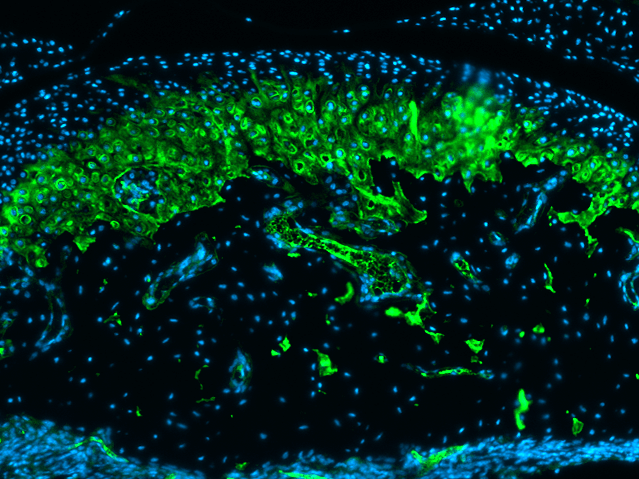
Osteoarthritis is a chronic degenerative disease in which the protective cartilage that provides cushion in joints gradually wears away, causing pain and decreased mobility.
Osteoarthritis in the temporomandibular joint, or TMJ – affects 5-10% of the U.S. population. TMJ osteoarthritis may begin with mild jaw discomfort, stiffness, clicking or grinding, and pain during chewing or opening the mouth. As the disease progresses, it can cause persistent severe pain, restricted jaw movement or locking, headaches, ear-area pain, difficulty eating and speaking, and substantial impairment of daily activities. Treatments for TMJ osteoarthritis are limited, often involving replacement of tissue with inorganic materials.
A new ADA Forsyth Institute research project aims to develop novel directions for TMJ osteoarthritis treatment, focusing on stem cells and regenerative treatments. The project, funded by an NIDCR R01 grant of $3.5 million over five years, explores potential new regenerative treatment targets for TMJ osteoarthritis.
“TMJ osteoarthritis limits essential functions like speaking, eating, or talking, and new methods for regenerative treatments can make a big difference in quality of life for patients,” said Takamitsu Maruyama, Ph.D., the award’s principal investigator. “Building on our previous research, this project could create new insight to treating the TMJ and other joints.”
Dr. Maruyama, Assistant Professor at ADA Forsyth, is a stem cell biologist who focuses on understanding how endogenous stem cells can regenerate the body’s natural tissue.
In this project, Dr. Maruyama and his research team explore the role of a class of non-coding RNAs, known as microRNAs, in the regeneration or degradation of tissue in the unique cartilage structure of the TMJ.
Thirty years ago, non-coding RNAs appeared to serve little purpose to the scientific community. Scientists at the time put their focus on the 2% of RNA in the human genome that code proteins; non-coding RNAs were mostly ignored as little more than biological debris. However, microRNAs later became a stronger focus for biologists thanks to improved research technology and influential studies such as those completed by Drs. Victor Ambros and Gary Ruvkun, who were honored with a Nobel Prize in 2024 for their discovery of microRNAs during the 1980s and 90s.
“Now, we look at microRNAs as important to understanding the way cells regulate growth and keep the body healthy,” Dr. Maruyama said. “If they weren’t important, they would not have survived evolutionarily.”
Dr. Maruyama’s team has removed specific types of microRNAs in previous experiments, demonstrating that without them, tissue does not regenerate the same way.
“We are excited about Dr. Maruyama’s innovative epigenetic approach to TMJ osteoarthritis,” said Ben Wu, D.D.S., Ph.D., ADA Forsyth’s Chief Scientific Officer and Chief Operating Officer. “By uncovering novel mechanisms and identifying new regenerative targets, this research has the potential to advance treatment beyond symptom management toward restoration the body’s own natural tissues and provide lasting relief for patients.”


