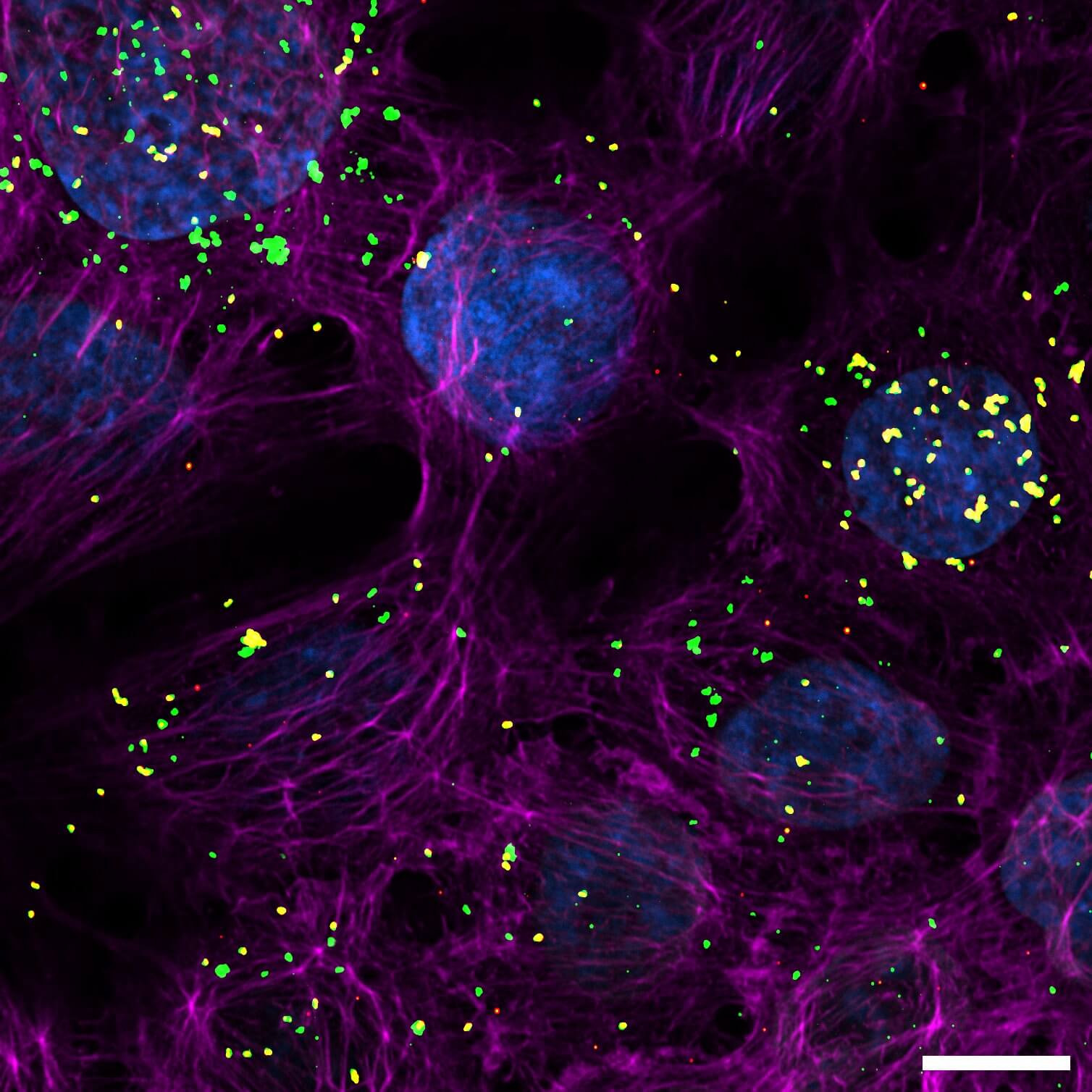
In a newly published study, ADA Forsyth Institute Associate Professor Batbileg Bor, Ph.D., and postdoctoral fellow Deepak Chouhan, Ph.D., led a research team to a fundamental discovery about Saccharibacteria, revealing mechanistic insights into their function in the oral microbiome, their role in immune modulation, and, importantly, their contribution to gum disease (periodontitis).
Saccharibacteria are ultrasmall bacteria that live on the surface of larger bacteria hosts, forming a relationship known as episymbiosis. Episymbiotic (Patescibacteria) bacteria make up about 25% of total microbial diversity and much remains unknown about their influence on microbial ecology. As such, they are considered “microbial dark matter.”
While some details are emerging about how Saccharibacteria interact with their bacterial hosts, one key mystery about Saccharibacteria’s role in periodontitis has persisted even as scientists around the world have studied it: How exactly does Saccharibacteria interact with the human host?
A groundbreaking new study led by the ADA Forsyth team, published in Nature Communications, offers novel findings that demonstrate how Saccharibacteria affects human epithelial cells – the cells that make up the protective, mucosal lining of the oral cavity.
“This study shows in great detail several previously unknown aspects of Saccharibacteria’s interaction with human cells,” said Dr. Bor. “This work, bringing mechanistic insight into a largely unknown study area in the oral cavity, advances the field of ultrasmall bacteria significantly, lending us new ideas for studying, and potentially treating, periodontitis.”
Saccharibacteria are strongly enriched in oral microbiomes associated with inflammation. Their hosts – microbes from the Schaalia or Actinomyces groups – are associated with health but can become opportunistic pathogens. From an early stage, scientists were clued in on Saccharibacteria as potentially important components to oral disease.
The research team discovered that Saccharibacteria interact with human gingival epithelial cells via toll-like receptor 2 (TLR2). TLR2 receptors are mechanisms on the surface of human cells which detect foreign substances and set in motion inflammatory responses. Saccharibacteia are internalized by caveolin-mediated endocytosis, a process by which cells actively envelop external materials through their membrane invagination.
During endocytosis by human epithelial cells, Saccharibacteria hinder TLR2 -mediated cytokine signaling, resulting in the dampened inflammatory response induced by host/non-host bacteria.
“Upon binding with gingival cells, Saccharibacteria clustered TLR2 receptors, taking them inside the cell. That leaves fewer receptors on the surface of the human cell, to which host/non-host bacteria could interact, so inflammation may not be signaled as intensely as it would be,” said Dr. Chouhan, lead author of the paper.
Previous mouse studies by the same group showed that Saccharibacteria reduces bone loss and inflammation, but scientists do not know exactly how. The group’s new study, focusing on human cells, presents exciting new insights.
This study focused on the earliest stages of the human immune response: the innate immune system and physical interactions. Dr. Chouhan said he is looking forward to exploring immune cell interaction with Saccharibacteria and subsequent altered gene expression within Saccharibacteria, their host bacteria, and immune cells using in vitro and in vivo periodontal disease models and innate/adaptive immune cells.
Contributors to the study, based at ADA Forsyth unless otherwise noted, included Dr. Chouhan, Alex Grossman, Kristopher A. Kerns (University of Washington), Kendall S. Stocke (University of Louisville), Maya Kim, Pu-Ting Dong, Ajay Kumar, Lei Lei, Richard J. Lamont, Jeffrey S. McLean (University of Washington), and Drs. He and Bor.


